Wildfire Preparedness Guide for People With Disabilities
Wildfires can strike with little warning, leaving limited time to gather supplies, communicate with others, or navigate evacuation routes. For people with disabilities — whether physical, sensory, cognitive, or psychiatric — standard emergency planning may not address the real barriers they face during a wildfire event.
This guide provides targeted, actionable guidance for individuals with disabilities across all age groups, as well as the caregivers, family members, and support networks who help them.
Why Standard Wildfire Guidance Falls Short
Most emergency preparedness guides assume that individuals can hear alerts, read notifications, move quickly, drive a vehicle, and make rapid decisions under stress. For tens of millions of Americans living with disabilities, these assumptions can be life-threatening.
According to the Federal Emergency Management Agency (FEMA) and disability advocacy organizations, people with disabilities are disproportionately affected during natural disasters.
They are more likely to delay evacuation, face physical barriers during escape, lack access to accessible shelters, and experience greater health consequences from smoke exposure.
Preparation tailored to your specific needs and shared with your community is the most effective way to close that gap.
Step 1: Build Your Personal Emergency Network
No person with a disability should plan to manage a wildfire emergency alone. A Personal Emergency Network (PEN) is a group of trusted individuals who know your needs, your plan, and how to help.
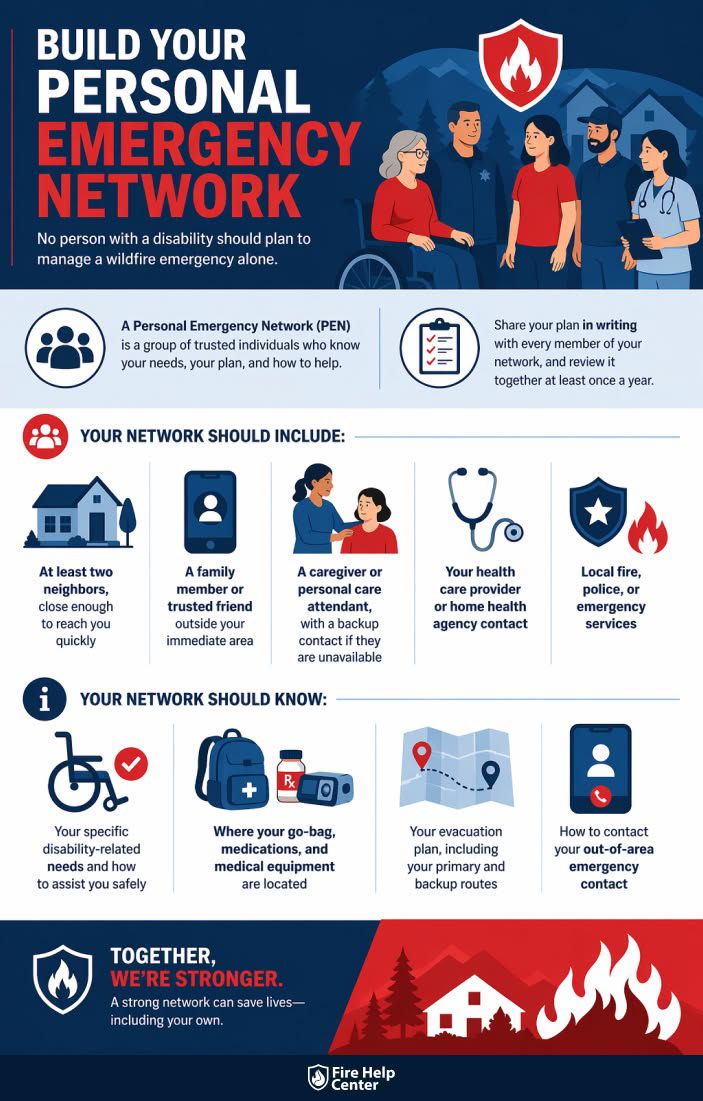
Your network should include:
- At least two neighbors, close enough to reach you quickly
- A family member or trusted friend outside your immediate area
- A caregiver or personal care attendant, with a backup contact if they are unavailable
- Your health care provider or home health agency contact
- Local fire, police, or emergency services
Your network should know:
- Your specific disability-related needs and how to assist you safely
- Where your go-bag, medications, and medical equipment are located
- Your evacuation plan, including your primary and backup routes
- How to contact your out-of-area emergency contact
Share your plan in writing with every member of your network, and review it together at least once a year.
Step 2: Register with Local Emergency Programs
Many counties, cities, and utility companies maintain voluntary registries for residents who may need evacuation assistance or priority service restoration during emergencies.
Registering can mean the difference between being overlooked and receiving a proactive welfare check or transport offer.
Registries to look for include:
- Local emergency management Access and Functional Needs (AFN) registries: Many counties maintain these lists to help first responders identify residents who may need evacuation assistance.
- Utility medical baseline or life support programs: Contact your electric utility company to register medical equipment (oxygen concentrators, ventilators, and power wheelchairs) for priority restoration and advance shutoff notification.
- Local paratransit or accessible transportation services: Contact your regional transit authority to ask about emergency evacuation arrangements for paratransit users.
- 211 social services hotline: Dialing 2-1-1 connects you with local disability services, emergency support resources, and shelter information.
Registration does not guarantee assistance, but it significantly increases the likelihood that you will be included in evacuation support efforts.
Step 3: Create Your Disability-Specific Go-Bag
The standard wildfire go-bag checklist does not account for the supplies, equipment, or documentation that people with disabilities rely on daily.
Your go-bag should be customized to your specific needs and kept in an accessible, easy-to-grab location.
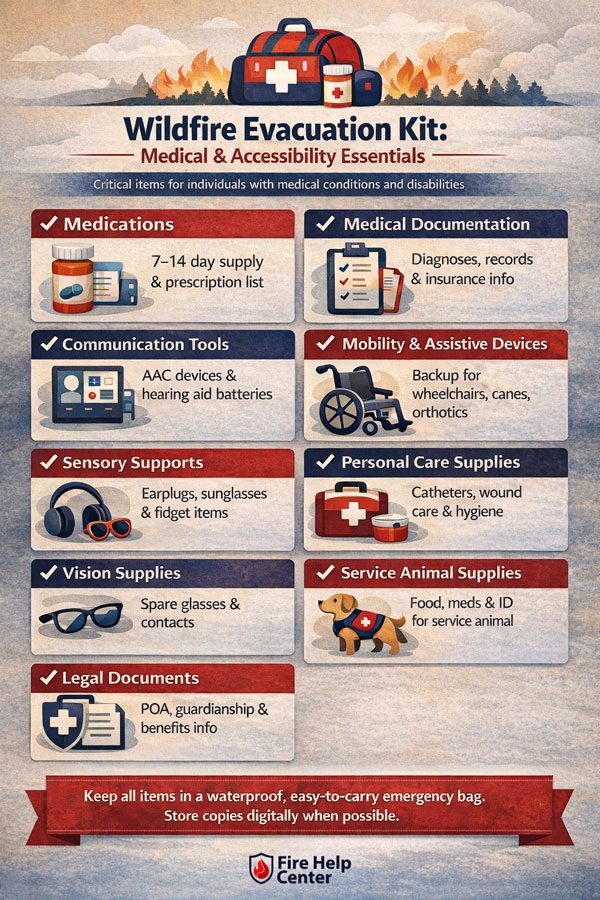
In addition to standard go-bag items, include:
- Medications: A 7-14 day supply, clearly labeled, along with a written list of all prescriptions, dosages, prescribers, and pharmacy contacts
- Medical documentation: Diagnoses, treatment summaries, immunization records, insurance cards, and a list of your health care providers
- Communication tools: AAC (augmentative and alternative communication) devices, letter or picture boards, extra hearing aid batteries, or pre-written communication cards
- Mobility and assistive device supplies: Manual backup for power wheelchairs, extra crutches or a cane, orthotic devices, repair tools, or charging cables
- Sensory supports: Earplugs or noise-canceling headphones, sunglasses, fidget tools, or comfort items that help manage sensory or mental health symptoms under stress
- Personal care supplies: Catheters, ostomy supplies, wound care materials, gloves, or any other items required for daily personal care
- Spare eyeglasses or contact lens supplies: To last while you’re away from home
- Service animal supplies: Food, water, medications, documentation, and a vest or ID for your service animal
- Copies of legal documents: Power of attorney, guardianship paperwork, disability benefits documentation, and health insurance information
Keep a second, lighter version of essential items (medications, communication tools, and ID) in a small “grab-and-go” pouch for situations where a full bag cannot be carried.
Step 4: Plan Your Evacuation in Detail
Evacuation planning must account for the specific barriers your disability creates. A generic plan of “leave when ordered” is not enough.
Questions to work through in advance:
- Can you evacuate without assistance? If not, who is responsible for helping you, and who is the backup if that person is unavailable?
- What is your evacuation vehicle, and is it accessible? If you use a wheelchair-accessible vehicle, is it always fueled and ready?
- Do your evacuation routes include accessible roads, ramps, and entrances to shelters? Have you driven or traveled them in advance?
- If you need paratransit or a medical transport service, what is the advance notice requirement, and do they operate during wildfires?
- If you cannot drive and your support person is unavailable, what is your backup plan?
- Have you identified accessible evacuation shelters in advance, including their hours, policies on service animals, and availability of accessible restrooms and sleeping areas?
Practice your plan. A dry run of physically going through the steps of gathering your bag, contacting your network, and traveling your route reveals problems that planning on paper does not.
Step 5: Prepare Your Home
While basic home preparation steps apply here, additional considerations should be made for accessibility and medical equipment.
To prepare your home:
- Keep mobility pathways clear. Defensible space and indoor safety matter equally. Ensure exits, hallways, and pathways to your go-bag are always clear of clutter or furniture.
- Secure backup power for medical equipment. Generators, battery backups, or power banks should be maintained, tested, and used only as recommended for each device. Know the runtime of your backup power and have a plan if it runs out.
- Post a copy of your emergency plan and needs near your front door. First responders can access this information quickly if you need rescue assistance.
- Use smart home or assistive technology alerts. Smart speakers, vibrating bed shakers, strobe-light smoke detectors, and automated text alerts can supplement standard warning systems for people with hearing or cognitive disabilities.
Taking these steps now can help ensure your home remains a safe, functional space and that you’re not scrambling to adapt in an emergency.
Disability-Specific Guidance
Every disability is different, and preparedness strategies should reflect that. The sections below address common categories of disability. Many people live with multiple conditions, so use the guidance that applies to you.
Physical and Mobility Disabilities
People who use wheelchairs, walkers, crutches, or prosthetics, or who have limited stamina due to conditions such as multiple sclerosis, spinal cord injury, or chronic illness, may face serious physical barriers to rapid evacuation.
Key planning priorities:
- Designate an evacuation helper. Identify at least two people who can physically assist you out of your home and into a vehicle. Practice the transfer or assistance technique with them in advance.
- Know the limits of your mobility device. Power wheelchairs are heavy and may not fit in all vehicles. Manual chairs are more portable but require a helper. Know what terrain your device can handle and what it cannot.
- Plan for uneven terrain. Evacuations may require navigating debris, uneven pavement, or unpaved ground. Identify potential obstacles along your evacuation route.
- Smoke and physical exertion. Elevated heart rate and physical exertion increase the risk of smoke inhalation. Wear an N95 mask and pace yourself. Notify your helper if you need to slow down.
- Alert first responders. If you are unable to evacuate, call 911 immediately and place a bright marker (towel, flag, or sign) visible from the street. First responders are trained to assist individuals with mobility limitations.
For children with mobility disabilities, caregivers should practice evacuation lifts and transfers in advance. School emergency plans should document the child’s evacuation needs and designate trained staff to assist.
Older adults who use assistive devices or have limited stamina are among the most vulnerable in wildfire evacuations. Early evacuation before orders are issued is strongly recommended. Arrange transportation help in advance and do not wait for conditions to worsen.
Blindness and Visual Impairments
People who are blind or have low vision may not be able to read visual emergency alerts, see smoke or flames until they are dangerously close, or navigate unfamiliar evacuation routes safely.
Key planning priorities:
- Use accessible alert systems. Register for emergency alert systems that offer phone calls and text messages. Enable Wireless Emergency Alerts (WEA), which deliver audio and vibration notifications to mobile phones. Use a NOAA weather radio with audio alerts.
- Know your home and route by feel. Practice navigating your home to all exits without visual guidance. Walk your primary and backup evacuation routes in advance, so they are familiar if conditions are smoky and visibility is low.
- Service dogs. If you use a guide dog, include the dog’s supplies in your go-bag. Confirm in advance that evacuation shelters accept service animals (they are legally required to under the Americans with Disabilities Act).
- Inform your Personal Emergency Network. Make sure network members know to call you, not just text, and to describe conditions verbally when assisting you.
- Label and organize your go-bag. Use tactile labels, rubber bands, or different bag textures to distinguish items you will need to locate quickly.
For children with visual impairments, coordinate with school staff to ensure the child’s evacuation plan is included in the school’s emergency protocol. Practice evacuation drills at home so the child is familiar with the steps and sounds.
Deafness and Hearing Loss
People who are deaf or hard of hearing may not hear standard auditory alerts, including smoke alarms, emergency broadcasts, sirens, or verbal instructions from first responders.
Key planning priorities:
- Install visual and vibrating alert systems. Replace standard smoke detectors with models that include strobe lights and bed shakers. Test them regularly.
- Enable visual and text-based emergency notifications. Sign up for emergency alert systems that deliver text messages. Enable WEA on your phone and make sure it is set to vibrate. Use captioned television or apps like the Emergency Alert app.
- Have a communication plan with first responders. Carry a communication card that identifies you as deaf or hard of hearing and provides written instructions for first responders. Many first responders are trained to write notes or use basic signs.
- Nighttime preparedness is critical. Most hearing aid users remove their devices at night. A vibrating or strobe alarm, including a bed shaker under the mattress, is essential for nighttime fire detection.
If your child is deaf or hard of hearing, work with their school to ensure they are included in all emergency drills with appropriate accommodations. Practice emergency routines at home, so children can respond quickly, even without hearing aids or cochlear implants in place.
Many older adults do not identify as hard of hearing but may miss auditory alerts. Strobe smoke detectors and text-based alert systems are recommended for anyone with reduced hearing, even mild loss.
Cognitive, Intellectual, and Developmental Disabilities
Individuals with cognitive disabilities, including intellectual disabilities, autism spectrum disorder, traumatic brain injury (TBI), Down syndrome, or dementia, may have difficulty understanding and acting on emergency instructions, managing stress under pressure, or communicating their needs to first responders.
Key planning priorities:
- Use simple, visual emergency plans. Create a picture-based or step-by-step visual checklist of what to do during an evacuation. Post it in a visible location at home. Practice the steps repeatedly so they become routine.
- Practice drills frequently. Familiarity reduces panic. Conduct regular home evacuation drills and frame them calmly and positively. Some individuals may need many repetitions before the steps feel automatic.
- Prepare a communication card. Include the person’s name, emergency contacts, disability, communication preferences, behavioral considerations, and medical needs. Keep it in the go-bag and on the person when evacuating. Consider a medical ID bracelet or wearable tag with emergency contact information.
- Identify sensory and behavioral triggers. Wildfires involve noise, chaos, smoke, and disrupted routines, all of which can be distressing. Pack comfort items, noise-canceling headphones, or sensory tools. Inform helpers and shelter staff about known triggers in advance.
- Caregiver backup. If the primary caregiver is unavailable, ensure a trained backup person knows the individual’s full routine, communication needs, and evacuation plan.
Schools are required to have individualized emergency plans for students with IEPs or 504 plans. Parents should review and update these plans annually and ensure they are coordinated with the family’s home plan.
For older adults, dementia can cause confusion, wandering, or an inability to follow instructions under stress. Early evacuation is critical. Alert neighbors and first responders to the individual’s condition. Consider a door alarm or GPS tracking device to prevent wandering during emergencies.
Mental Health and Psychiatric Disabilities
People living with post-traumatic stress disorder (PTSD), schizophrenia, bipolar disorder, severe anxiety, or major depression may experience intensified symptoms during wildfire emergencies.
The stress of evacuation, displacement, and loss can destabilize mental health even for those who are well-managed under normal conditions.
Key planning priorities:
- Prepare a mental health crisis plan. Identify warning signs that your condition is worsening under stress, and write down what helps. Share this plan with your PEN and any shelter staff.
- Protect your medication supply. Psychiatric medications must not be interrupted without medical guidance. Include a 14-day supply in your go-bag, with refill instructions and prescriber contact information.
- Identify your mental health contacts. Include your psychiatrist, therapist, and pharmacy in your emergency contacts. Know how to reach crisis lines (988 Suicide and Crisis Lifeline) if needed during or after the disaster.
- Have a decompression plan for shelters. Emergency shelters can be overwhelming, crowded, loud, and unpredictable. Identify a quiet area to retreat to, bring noise-canceling headphones or comfort items, and inform a trusted shelter staff member of your needs.
It’s also a good idea to plan for post-disaster mental health support. Wildfires are traumatic. Displacement, property loss, and community disruption can trigger or worsen mental health conditions for weeks or months afterward. Seek support early rather than waiting for symptoms to intensify.
Chronic Illness and Medical Dependencies
People with chronic illnesses, like heart disease, diabetes, kidney disease, cancer, or autoimmune conditions, may face specific risks during wildfires related to smoke exposure, medication access, and disruption of ongoing treatments.
Key planning priorities:
- Know your smoke exposure risks. Wildfire smoke is especially dangerous for individuals with respiratory or cardiovascular conditions. Check the Air Quality Index (AQI) daily during fire season and limit outdoor exposure when air quality is poor. Use HEPA air purifiers indoors and wear a properly fitted N95 mask when outdoors.
- Protect your medication continuity. Ask your doctor about getting a larger-than-usual supply of critical medications before wildfire season. Know the storage requirements for temperature-sensitive medications such as insulin.
- Dialysis and infusion patients. Contact your dialysis center or infusion provider before fire season to ask about their emergency protocols. Know in advance where backup treatment facilities are located in case your primary center is inaccessible.
- Oxygen-dependent individuals. Contact your oxygen equipment supplier about portable backup units and emergency delivery procedures. Register with your utility for medical priority and inform your PEN about your oxygen needs.
Planning ahead for these needs can reduce health risks, prevent dangerous interruptions in care, and give you more control during an already unpredictable situation.
Speech and Communication Disabilities
People who use augmentative and alternative communication (AAC) devices, communicate via sign language, or have speech differences may face barriers communicating with emergency responders, shelter staff, or strangers during evacuation.
Key planning priorities:
- Prepare printed communication cards. Even if you use a digital AAC device, paper backups are essential. Include your name, emergency contacts, medical needs, and basic phrases (“I need help,” “I use a wheelchair,” “Please speak slowly”) on a card you carry at all times.
- Charge your devices before wildfire season peaks. AAC devices, tablets, and smartphones should be kept charged. Include charging cables and a portable power bank in your go-bag.
- Alert first responders. If you cannot communicate verbally during an emergency, wave, point, or use written communication as soon as possible. Many first responders have basic communication training, but a card with your name and needs significantly speeds up assistance.
Preparing these tools in advance can help ensure your needs are understood quickly when every second counts.
Accessible Shelter Planning
Not all emergency shelters are equally accessible, and arriving without knowing a shelter’s capabilities can create significant hardship.
Before wildfire season:
- Contact your county emergency management office to identify which shelters are ADA-accessible, including accessible parking, restrooms, sleeping areas, and paths of travel.
- Ask about medical needs shelters or “special needs shelters” in your region. These are designed for people who require ongoing medical care or have complex support needs.
- Identify pet-friendly accessible shelters if you have a service animal or pet.
- Contact the shelter in advance to ask about accommodations for your specific disability.
At the shelter, identify yourself and your needs to a shelter coordinator upon arrival. Ask about the location of accessible restrooms, quiet areas, and medical staff.
Let staff know if you require refrigerated medication storage, a charging area for medical equipment, or personal care assistance.
During the Wildfire: A Quick List of What to Do
If you are ordered to evacuate:
- Contact your Personal Emergency Network immediately and begin your evacuation plan.
- Alert your transportation helper or paratransit service.
- Take your go-bag, medications, assistive devices, and service animal.
- If you need rescue assistance and cannot evacuate, call 911, stay calm, and place a visible marker outside your home.
If you must shelter in place:
- Close all windows and doors and seal gaps to reduce smoke entry.
- Use your HEPA air purifier and avoid all indoor smoke sources.
- Monitor alerts via all available channels — audio, text, and visual.
- Contact your PEN and let them know your location and condition.
Protect yourself from smoke:
- Wear a properly fitted N95 mask, not a cloth mask or surgical mask, if any outdoor exposure is unavoidable.
- Do not engage in physical exertion outdoors when AQI is elevated as this significantly increases smoke inhalation.
- If you are oxygen-dependent, contact your supplier and medical provider for guidance on managing smoke exposure.
After the Wildfire: Recovery for People With Disabilities
Recovery from a wildfire is often harder and longer for people with disabilities. Barriers to accessing disaster assistance, displacement from accessible housing, and disruption of support services can compound the initial harm.
Immediate steps:
- Return home only after official clearance. Ash, debris, and air quality risks are especially serious for individuals with respiratory, cardiovascular, or immune conditions.
- Check in with your health care providers, home health agency, and caregiver services as soon as possible to restore your care routine.
- Contact your equipment supplier if assistive devices were damaged or lost.
Accessing disaster assistance:
- FEMA’s Individuals and Households Program provides grants for housing, personal property, and other disaster-related expenses. FEMA is required to provide accessible application assistance to people with disabilities. Request accommodations when you apply.
- Contact your state vocational rehabilitation agency if disability-related equipment or supports were lost or damaged.
- The ADA National Network (1-800-949-4232) provides free guidance on disability rights in disaster situations.
- Contact 2-1-1 for local disability services, food assistance, mental health support, and shelter referrals.
- Wildfire victims may be eligible for other support, as well as financial support to make the road ahead easier.
Mental health and emotional recovery:
Wildfire disasters are traumatic, and recovery can take months. Seek support early.
Options include:
- FEMA crisis counseling programs (activated after federal disaster declarations)
The 988 Suicide and Crisis Lifeline (call or text 988) - SAMHSA’s Disaster Distress Helpline (1-800-985-5990)
- Local nonprofit organizations and community disability support groups
Reaching out early can make a meaningful difference by helping you process the experience, reduce long-term stress, and begin recovery with the support you deserve.
Summary: Key Actions at Every Stage
Before
Build your PEN, register with local programs, customize your go-bag, plan accessible evacuation routes, and prepare backup power
During
Activate your network, follow your plan, alert 911 if you need rescue assistance, limit smoke exposure
After
Restore medications and care services, document losses, apply for FEMA and disability-specific assistance, and prioritize mental health
Additional Resources
Having the right contacts and tools can make a critical difference before, during, and after a wildfire emergency, especially when accessibility and medical needs are involved.
Key resources to know:
- Ready.gov (Disability Preparedness): Visit Ready.gov/disabilities for FEMA’s step-by-step guidance on emergency planning tailored to people with disabilities, including evacuation, communication, and supply checklists.
- ADA National Network: Call 1-800-949-4232 or visit adata.org for information about your rights during emergencies, including access to shelters, transportation, and public services.
- 211 Helpline: Dial 2-1-1 to connect with local resources, including emergency housing, transportation, food assistance, and disability support services in your area.
- 988 Suicide and Crisis Lifeline: Call or text 988 for immediate, confidential mental health support — available 24/7 before, during, or after a disaster.
- SAMHSA Disaster Distress Helpline: Call 1-800-985-5990 for crisis counseling and emotional support related specifically to disaster-related stress and trauma.
- NOAA Weather Radio: A reliable source of real-time emergency alerts, including severe weather and wildfire updates. Many devices offer accessible features like voice alerts and visual signals.
- CAL FIRE: Visit readyforwildfire.org for wildfire-specific preparedness tips, evacuation guidance, and real-time alerts, especially useful for those in high-risk regions like those in California.
- FEMA Disaster Assistance: Apply for disaster aid at DisasterAssistance.gov, including financial help for housing, medical needs, and essential expenses after a declared disaster.
Tip: Save these numbers in your phone, write them on a printed emergency card, and share them with caregivers or family members so they’re easy to access when you need them most.

You Deserve a Plan That Works for You
Wildfire preparedness isn’t one-size-fits-all, and it shouldn’t be. The most effective plan is one that reflects your daily needs, your environment, and the support systems you rely on.
Take time to personalize your plan, practice it with the people who support you, and update it as your needs change. Small steps like organizing supplies, documenting medical needs, or identifying backup support can make a meaningful difference when time is limited.
Preparing ahead isn’t about expecting the worst — it’s about giving yourself the tools, support, and confidence to respond when it matters most.
Contact us now if you or a loved one was affected by a wildfire. Compensation may be available to help you move forward.

Written by: Fire Help Center
Fire Help Center was founded to support individuals and families affected by wildfire-related loss and disaster. Our mission is to provide clear, reliable resources that help people navigate recovery, prevention, and preparedness strategies. We work to ensure no one has to face the aftermath of a wildfire alone.
- Federal Emergency Management Agency (FEMA). “Individuals with Disabilities and Access and Functional Needs in Emergency Management.” Retrieved from: https://www.fema.gov/emergency-managers/individuals-with-disabilities.
- Ready.gov (FEMA). “People with Disabilities and Access and Functional Needs.” Retrieved from: https://www.ready.gov/disability.
- Centers for Disease Control and Prevention (CDC). “Emergency Preparedness for People with Disabilities.” Retrieved from: https://www.cdc.gov/ncbddd/disabilityandhealth/emergencypreparedness.html.
- ADA National Network. “Emergency Preparedness and the ADA.” Retrieved from: https://adata.org/emergency-preparedness.
- National Council on Disability (NCD). “Preserving Our Freedom: Ending Institutionalization of People with Disabilities During and After Disasters.” Retrieved from: https://www.ncd.gov.
- American Red Cross. “Preparing for Disasters for People with Disabilities and Other Special Needs.” Retrieved from: https://www.redcross.org.
- SAMHSA. “Disaster Distress Helpline and Mental Health Resources.” Retrieved from: https://www.samhsa.gov/disaster-preparedness.
- California Governor’s Office of Emergency Services (Cal OES). “Access and Functional Needs.” Retrieved from: https://www.caloes.ca.gov.
- CAL FIRE. “Ready for Wildfire: Preparedness and Home Hardening Guidance.” Retrieved from: https://readyforwildfire.org.
- U.S. Fire Administration (USFA). “Fire Risks for People with Disabilities.” Retrieved from: https://www.usfa.fema.gov.