Wildfire Preparedness Guide for Children & Teens
Children and teenagers experience wildfires differently from adults. They may lack basic fire safety strategies, struggle with uncertainty, and not fully understand the dangers of an active fire without a wildfire preparedness guide.
Kids and teens can learn essential wildfire safety tips by reading our guide. They’ll feel prepared to help themselves and their family members in a crisis, regardless of their age.

How to Prepare Kids and Teens for Wildfires
Kids and teenagers might think wildfires only happen in distant places they see on the news, like California. Your family may become safer if you start with some basic facts that won’t scare your little ones.
The United States has an average of 61,410 wildfires annually, so families should be prepared throughout the country.
Key wildfire facts for kids to help them prepare include:
- Avoid breathing in any wildfire smoke, even if the fire is far away
- Check our Live Wildfire Map during fire season to stay alert
- Cover your mouth and nose during an evacuation to prevent smoke inhalation
- Evacuate immediately if a wildfire threatens your neighborhood
- Grab your go-bags if you need to leave the house
- Remember that fire risk is increasing because changing weather patterns and human negligence pose greater threats
- Stay alert, because ignition sources and high winds can start wildfires year-round
Having age-appropriate conversations about wildfires can help children feel prepared during an emergency. Once your kids understand the reality of wildfires, they should learn how to evacuate safely.
Call us at (866) 866-0753 if you’re unsure how to prepare your family for a wildfire. Our team is here to answer your questions and provide support before or after a fire.
Building Your Family’s Wildfire Evacuation Plan & Preparedness Guide
Having a wildfire evacuation plan in place — and making sure your kids understand it — are essential ways to proactively prepare your family.
A wildfire evacuation guide for kids can include steps like:
- Call 911 if you feel trapped by an advancing wildfire
- Call a parent or caregiver if you’re home alone
- Give the 911 dispatcher your home address if you need help evacuating
- Grab your go-bag
- Leave the area with your siblings (if applicable) through the nearest exit route
- Reach a previously arranged meet-up point, such as your mailbox
You can streamline a future evacuation by putting your go-bags in your car and gathering your pets if you get a local wildfire alert.
Consider keeping your evacuation steps in a kid-friendly, accessible location, like taped to your refrigerator or stored in a kitchen drawer.
Read through and practice your plan at least once a year, including a walkthrough of each evacuation route in your neighborhood. Doing so can ensure your kids know how to safely evacuate in the event of a wildfire impacting your home.
Creating Wildfire Go-Bags for Kids and Teens
The best wildfire preparedness checklists include go-bags in easy-to-reach locations. They help people evacuate their homes quickly without scrambling to gather supplies. Parents should prepare go-bags that include both essentials, as well as age-appropriate items, for each child.
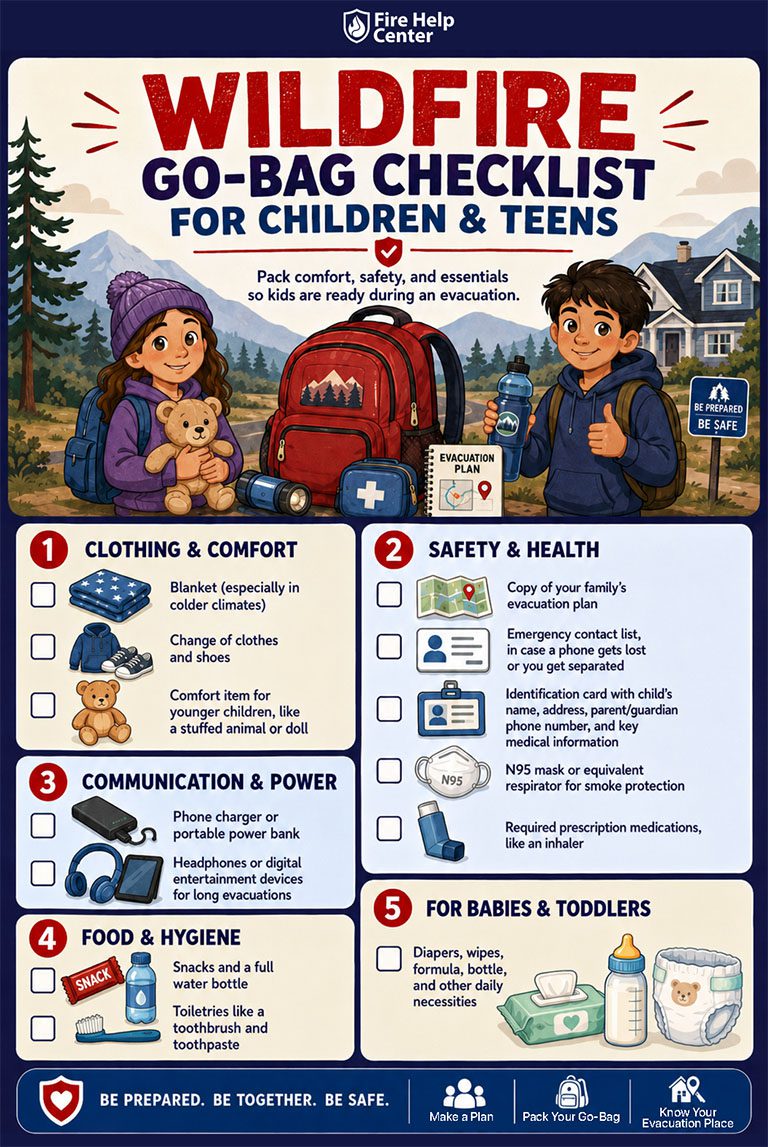
Wildfire go-bags for children and teens should have:
- A blanket, especially if you live in places with cold climates like Colorado
- A change of clothes and shoes
- A comfort item for younger children, like a beloved stuffed animal or doll
- A copy of your family’s evacuation plan
- A list of emergency contacts, in case your child’s phone gets lost or they become separated from you
- An identification card with your child’s name, address, parent or guardian’s phone number, and key medical information
- An N95 mask or equivalent respirator for smoke protection
- Any required prescription medications, like an inhaler
- A phone charger or portable power bank
- Essentials for babies like diapers, wipes, formula, a bottle, and other daily necessities
- Headphones or digital entertainment devices, which may help during extended evacuations
- Snacks and a full water bottle
- Toiletries, like a toothbrush and toothpaste
Remember to set quarterly or bi-annual reminders to update their go-bags with your wildfire preparedness checklist as well. Necessary supplies for a baby or young child may change every few months, such as their current formula or clothing size.
Discussing Wildfire Safety Tips and Plans With Kids
Having age-appropriate conversations about wildfire safety is crucial. Your kids should know how to prepare for a wildfire and respond to an evacuation notice, without feeling afraid of the world afterward.
The best conversations will be tailored to your child’s age:
- Children (4-8 years old): Young kids should know who can help keep them safe during a wildfire, such as parents, teachers, and firefighters.
- Preteens (9-12 years old): Give older kids more wildfire safety details and age-appropriate responsibilities, like packing their go-bags.
- Teenagers (13-18 years old): Assign leadership responsibilities and have in-depth discussions about wildfire dangers, while remembering that teens may not communicate their fears as easily as young kids.
The key is to give each child enough information so they understand the reality of wildfires and how to stay safe during an evacuation. They should leave your conversation feeling empowered, rather than scared or confused.
Contact us if you have any questions. Our team is here to connect you with support resources before and after wildfires.
Children Between 4-8 Years Old
Young children need simple information about wildfire safety. Focus on reassurance and basic safety rules while you talk.
Key wildfire safety tips for younger kids include:
- Do not go back into homes or other structures that are on fire
- Firefighters and first responders are here to help
- It’s almost always safer to get out of a building than hide inside during a fire
- Know two ways out of each room and out of your house
- Make sure you know how to stop, drop, and roll if clothes catch on fire
- Never play with or around matches, stoves, lighters, or space heaters
- When camping, keep a close watch on campfires and make sure they’re fully put out
- Wildfires are very big fires that can happen outside of your homes and schools
- You can call 911 if you get trapped during an evacuation or need help
- You need to memorize your home address for 911 calls
- You should find the nearest adult if you’re scared, like your parent, teacher, or a familiar neighbor
- You should know what steps to take if you hear a smoke detector go off and an adult is not present
Keep the conversation calm by avoiding graphic details or images that could scare your child. You can also ask if they have any questions or strong feelings about what you’re discussing.
Your Main Takeaway: Reinforce the idea that if your young child knows basic wildfire preparedness tips and finds the nearest adult for help, they’ll be much safer.
Older Children and Preteens Between 9-12 Years Old
Children in late elementary and early middle school can better understand information about wildfires. They may also be capable of handling basic responsibilities that can help keep them safe.
You can chat with your older kids or preteens about:
- Calling 911 if needed and providing important information, like their home address and how many people are home
- Covering their mouth and nose while staying low or evacuating a smoke-filled area
- Finding and following the family evacuation plan
- Knowing common wildfire ignition sources in their region and how they may spread
- Locating the nearest adult for help
- Meeting you at an agreed-upon safety point
- Packing essentials in their go-bag and taking it during evacuation
- Reviewing what local emergency alerts look like and where they come from
- Signing up for local wildfire alerts if your child has a cell phone
- Touching doors before entering rooms and finding another exit if they’re hot
Older kids can be more proactive with the responsibilities in your wildfire preparedness guide, which may reduce their anxiety. If you ask how they’re feeling throughout your conversation and welcome their questions, the experience will go smoothly.
Your Main Takeaway: Go into more detail with older children and give them age-appropriate tasks, like packing their go-bag and practicing what they’ll say to a 911 dispatcher.
Teens Between 13-18 Years Old
Teenagers can understand straightforward wildfire information and take charge if they’re home alone during emergencies. Your conversations about wildfire preparedness should reflect that, while reminding them that adults are here to help.
Wildfire preparedness tips for teenagers include:
- Cover their nose and mouth to prevent smoke inhalation, then make sure that anyone around them does so too
- Find evacuation routes from their home or school
- Give a 911 dispatcher essential information, like their current address, who’s with them, and if they need help getting out of the building
- Grab their go-bag
- Help evacuate pets if there’s enough time to safely do so
- Meet you at an agreed-upon safety point
- Memorize your phone number and at least one other emergency contact in case their phone fails
- Practice driving along evacuation routes if they have their permit or license
- Reassure and lead their siblings or friends to safety if needed
- Recognize the signs of a wildfire threat, like the smell of smoke or an orange-red sky color
- Sign up for local wildfire alerts on their cell phone
Even if your teen seems completely fine talking about wildfires, ask how they’re feeling or if they have questions. Wildfire safety conversations can feel scary for anyone, and they may want to seem grown-up by not voicing their concerns.
Your Main Takeaway: Give teenagers more information about wildfire preparedness and assign responsibilities they can handle. Be sensitive that they may still be scared or have questions, so leave room for those discussions throughout your conversation.
Explaining Smoke Inhalation Risks to Kids and Teens
Young kids and teenagers might not realize how dangerous wildfire smoke can be. They may assume that it’s fine to breathe as long as they’re far away from the smoke or outside.
Talk about how wildfire smoke contains pollutants that are too small to see. If they get into your lungs, the particles can harm your health.
Older kids and teens should know that breathing smoke can cause:
- Asthma attacks
- Chest pains
- Fatigue
- Headaches
- Heart palpitations
- Shortness of breath
- Sinus irritation
- Tired eyes
- Wheezing
Wildfire smoke is particularly dangerous for kids. Their lungs are still developing, and they breathe faster than adults. Children and teenagers should know the importance of covering their mouths and noses while a wildfire is nearby.
They should also practice using N95 masks to protect themselves during an evacuation. Keep them as a standard part of your family’s go-bags. If your kids can’t find their masks or go-bags, your wildfire preparedness guide should remind them to cover their mouths with fabric instead.

Supporting Your Child’s Emotional Well-Being Before a Wildfire
Wildfires can be frightening and disorienting for children and teenagers, especially if you live in urban New York, where they may feel less likely. Even seeing other people lose their homes or evacuate can cause lasting emotional distress.
You can provide emotional support by:
- Asking your child what’s on their mind throughout your conversation
- Giving your teen fire prevention duties, like mowing your grass when it’s tall
- Practicing wildfire evacuation drills once or twice a year
- Providing ways for them to help, like packing their go-bag
- Rehearsing what it’s like to call 911 and talk with a dispatcher
- Talking calmly about wildfire risks in age-appropriate ways
- Validating their concerns and reminding them that they’re not alone
Information can give many kids a sense of agency, but some may still feel worried even after you talk to them. Check in on how your child feels and give them the support they need so the experience has a lasting, positive impact.
Helping Kids and Teens Recover After a Wildfire
Wildfires are an overwhelming experience. Supporting teens and kids through their emotional recovery can help them feel safe again after tragedy.
Parents can help their kids and teens cope by:
- Answering questions honestly, but without intense details
- Discussing the community’s response to rebuilding and preparing for future wildfires
- Keeping normal routines to rebuild their sense of safety
- Limiting media exposure that could include traumatic images
- Teaching them anxiety-reducing skills, like slow breathing or counting
- Using active listening to meet their unspoken emotional needs
Recovering from a devastating fire is hard for everyone. If your family’s health or home has been impacted by wildfires, the Fire Help Center team is here to help you explore support options and move forward.
Call (866) 866-0753 now or get a free case review to find out how we may be able to assist you.
Wildfire Safety and Preparedness Guide for Kids and Teens FAQs
What are some safety tips for wildfires?
Safety tips for wildfires depend on a person’s age, so young kids and teens will need different wildfire conversations.
Kids and teenagers should learn basic wildfire safety tips, like:
- Asking an adult for help
- Covering their nose and mouth during an evacuation
- Learning how to call 911
- Packing and storing a go-bag
- Reaching an agreed-upon evacuation point
For younger kids, your goal should be teaching wildfire preparedness without scaring them. Ask them how they’re feeling and pause the conversation if it’s too much.
Teenagers and older kids can typically handle more responsibilities, like prepping go-bags and checking the Fire Help Center Live Wildfire Map for local threats.
How do we prepare for a wildfire?
Families can prepare for a wildfire by signing up for local fire alerts, creating an evacuation plan, and assembling go-bags for everyone. Keep regional-specific supplies ready, like a jacket for cold weather in Oregon or extra water for hot Arizona weather.
Talk with your kids about how they can help prepare for wildfires. If they know what’s in their go-bags and understand how to evacuate safely, wildfires will seem less scary.
What should be in a fire go bag?
A fire go-bag should contain essential supplies to keep you or your child comfortable. The specifics vary by each person’s age and medical needs.
A standard fire go-bag should include:
- A blanket
- An identification card
- An N95 mask or a respirator
- Extra clothes
- Medications
- Phone charger
- Snacks and at least one water bottle
- Toiletries
Your kids may also need comfort items, such as their favorite toys or electronic devices. If you update the go-bags while your child grows, everyone will have what they need during an evacuation.
How do you explain a wildfire to a child without scaring them?
Explaining a wildfire to a child requires a calm, reassuring approach that emphasizes how they can stay safe. If your child becomes fearful, they may not listen or remember what you say.
Focus on age-appropriate details, similar to how you might explain any other emergency situation.
You should also ask how they’re feeling or if they have any questions. You’ll provide better emotional support if you give them space to lead the conversation as well.
Contact us if you need help. We can answer your questions about wildfire preparedness conversations or support your family after a fire.

Written by: Fire Help Center
Fire Help Center was founded to support individuals and families affected by wildfire-related loss and disaster. Our mission is to provide clear, reliable resources that help people navigate recovery, prevention, and preparedness strategies. We work to ensure no one has to face the aftermath of a wildfire alone.
- CBS News. (2023). What to do during an air quality alert: Expert advice on how to protect yourself from wildfire smoke. Retrieved from: https://www.cbsnews.com/news/what-to-do-during-air-quality-alert-masks-protect-wildfire-smoke.
- Children’s Hospital Colorado. (2025). Wildfire smoke and kids: health effects. Retrieved from: https://www.childrenscolorado.org/just-ask-childrens/articles/wildfire-smoke/.
- National Aeronautics and Space Administration. (2025). Wildfires and climate change. Retrieved from: https://science.nasa.gov/earth/explore/wildfires-and-climate-change/.
- Mayo Clinic Health System. (2025). Understanding the complex health risks of wildfire smoke. Retrieved from: https://www.mayoclinichealthsystem.org/hometown-health/speaking-of-health/wildfire-smoke-complex-health-risks.
- U.S. Congress. (2023). Wildfire statistics. Retrieved from: https://www.congress.gov/crs_external_products/IF/HTML/IF10244.web.html.
- U.S. Environmental Protection Agency. (2025). Wildfire smoke – a complex mixture. Retrieved from: https://www.epa.gov/wildfire-smoke-course/wildfire-smoke-complex-mixture.
- Wildfire Partners. Managing grass on private land. Retrieved from: https://wildfirepartners.org/take-action/ready-set-mow/.