Wildfire Preparedness Guide for California
California experiences more wildfire activity than any other U.S. state. In 2025, a total of 8,232 fires burned more than 500,000 acres and killed 31 people, according to Cal Fire.
Households in California need to be prepared before disaster strikes. This guide will help residents understand the unique risks they face and what steps they can take to be ready for the next wildfire.

Why Californians Should Be Prepared for Year-Round Ignition Sources
California residents are used to planning for a summer fire season, but climate change has extended hazardous conditions throughout much of the year. Warmer temperatures and droughts make it easy for vegetation to catch fire from a spark or lightning strike.
Adding to the danger, Cal Fire found that 14 million Californians lived in areas of wildland-urban interface (WUI) as of 2020. The WUI has many structures built close to forests or grasslands, so wildfires are more likely to ignite because of human activity.
Year-round California wildfire ignition sources include:
Campfires
In September 2025, a campfire in Shasta-Trinity National Forest grew into the Root Fire and burned 729 acres.
Equipment
A man was accused of starting the August 2026 Gann Fire by using equipment that caused sparks near vegetation.
Fireworks
Smoke bombs that were launched for a gender-reveal photo shoot accidentally sparked the destructive 2020 El Dorado Fire.
Lightning
In August 2025, lightning strikes in the midst of a heat wave ignited several small fires across Southern California.
Power lines
The deadly January 2025 Eaton Fire was started by sparks from a Southern California Edison transmission tower.
The fastest-moving and most destructive blazes are often driven by offshore winds that peak in fall and winter: Santa Ana winds affect Southern California, and Diablo winds are the Northern California equivalent.
These winds begin as cold, high-pressure air over the deserts and mountains. They warm up as they descend, arriving at the coast hot, dry, and fast.
The January 2025 Palisades Fire and the 2017 Tubbs Fire were both wind-driven wildfires that developed from ignition to widespread destruction faster than many residents could react. Being prepared for wildfires year-round could help people evacuate faster when future fires start from common ignition sources.
Plan for an Evacuation in California
When developing your evacuation plan, keep in mind that fires in California can move fast. Working out the details in advance will save your family critical time if you need to leave home with little warning.
Make these evacuation steps the foundation of your California wildfire preparedness guide:
- Keep your vehicle fueled and ready during red flag warning periods.
- Know the predesignated evacuation zone for your community.
- Register to receive emergency alerts from local authorities.
- Plan backup routes in case your primary route is blocked.
- Run drills with your family to ensure everyone knows what to do.
- Set a family meeting location outside the immediate risk area.
Avoid waiting too long to evacuate. Fires driven by offshore winds may spread rapidly, and routes can close within hours.
For households with young children, older adults, or anyone with mobility limitations, it’s especially important to allow yourself extra time to get on the road. Having an evacuation plan ready could give you that life-saving time.
Packing Your Wildfire Go Bag
With the high risk of wildfires, California families should always have an emergency kit, or “go bag,” packed and ready. Include all the essential supplies your family may need for up to 3 days.
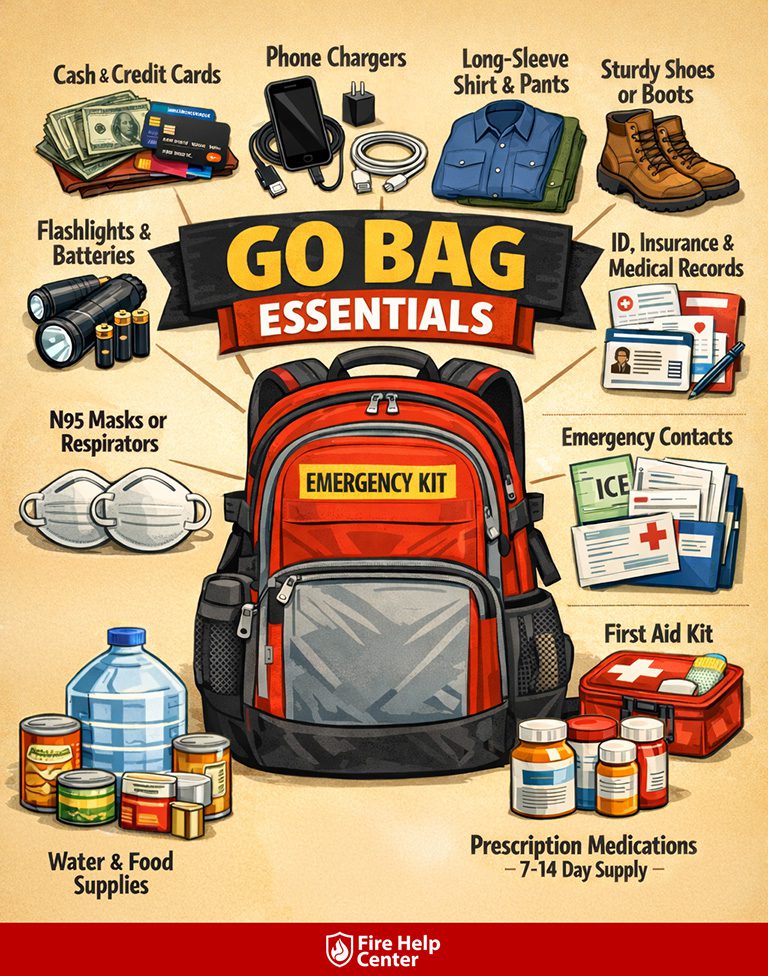
Prepare your go bag with these items:
- Battery-powered radio
- Car keys
- Change of clothes
- Copies of important documents
- Eyeglasses or contact lenses
- First aid kit
- Flashlight
- Map marked with evacuation routes
- Money
- Non-perishable food
- Pet supplies
- Prescription medications
- Water
Go-bags are for evacuation essentials, but you can include irreplaceable belongings if they’ll hold up well in your storage bin or bag. This may keep your loved ones from running back inside for photo albums or legal documents when a wildfire is close.
Follow California’s Defensible Space Law to Prepare Your Home for Wildfires
Homes need defensible spaces, or buffer zones, that can prevent flames from reaching your house and give firefighters room to work if necessary.
Homes with defensible space and hardened features like fire-resistant roofs and advanced venting are more likely to make it through a fire. These modifications increase the chances of a structure’s survival by 40%, per Nature Communications.
California has some of the most detailed rules in the country for how homeowners must maintain defensible space. Local ordinances may also have stricter requirements.
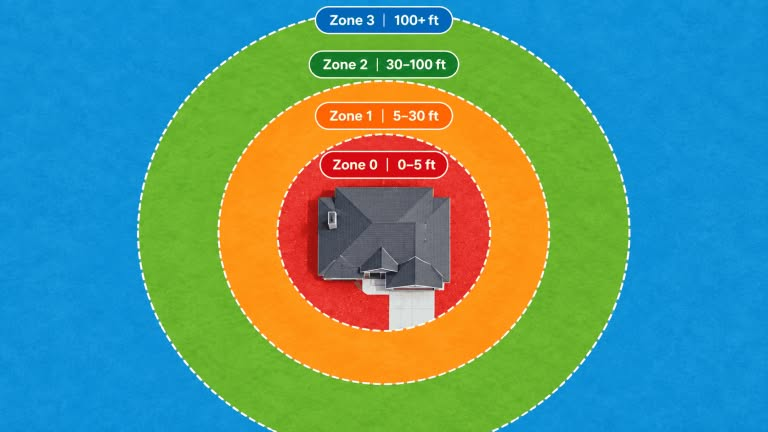
These requirements in California’s defensible space law may reduce wildfire damage risk:
- Clearing dead vegetation, leaves, and debris out of the defensible space area
- Removing any lawns, flowers, and nonwoody plants from directly beneath the roofline and trimming any greenery within 5 feet of the home below 18 inches tall
- Spacing out trees and shrubs to prevent flames from spreading between plants
- Thinning dense vegetation within the outer zone to slow an approaching fire
- Trimming tree branches so the end of each branch is at least 5 feet away from the house
Defensible space is split into 3 zones that stretch up to 100 feet from your house. The rules for Zone Zero, the area within 5 feet of the home, are still being phased into enforcement until 2029. However, taking action to protect this space now will help you stay safe and prepare for inspections.
Prepare for Public Safety Power Shutoffs
Wildfire-related power outages in California are not always caused by fire damage. Utilities may shut off power on purpose when weather conditions increase the risk of electrical equipment starting a fire. This is called a Public Safety Power Shutoff (PSPS).
You can prepare for a PSPS by:
- Charging phones and medical devices
- Enrolling in utility alerts, since notifications can arrive up to 3 days before a shutoff
- Getting a backup power source for medical devices
- Learning to manually open any automatic garage doors
- Putting a reminder to refrigerate medications in an ice chest if your power will be out for more than 3 hours
- Saving enough food in case you go multiple days without power
Utility companies anticipate that PSPS events may become more common and last longer, CBS News reported. With the rising dangers from wildfires, California residents need to be prepared to manage without power even when there are no evacuation orders or an active wildfire.
Check Your California Homeowners Insurance Coverage
Getting insurance coverage for wildfire losses in California has become harder and more complicated. The average homeowners insurance premium rose by 84% from 2020 to 2026, according to the Stanford University Climate and Energy Policy Program.
The challenges in getting and keeping coverage make it especially important for California homeowners to plan ahead.
California homeowners should prepare for wildfire-related insurance needs by:
- Confirming coverage limits and deductibles before wildfire season, not after a loss
- Documenting their home’s condition with annual photos or video
- Keeping copies of policy documents somewhere accessible outside the home
- Learning how fire mitigation efforts can help their coverage and costs
California’s insurance regulators have been phasing in reforms that require insurers to expand coverage in wildfire-prone areas. Taking steps like creating defensible space and hardening your home are increasingly factored into coverage and pricing decisions.
Create a Wildfire Response Plan
It’s important to be cautious when returning home after a wildfire. Even after the flames are fully contained, there could still be dangers left behind.
When returning home, you should:
- Confirm that CAL FIRE or local officials have declared the area safe to re-enter.
- Contact your homeowners insurance company to report property damages or losses.
- Document fire damage thoroughly with photos and video before any cleanup begins.
- Inspect for hazards such as damaged power lines, weakened trees, or unstable structures.
- Look for signs of soil damage that could lead to mudslides during the next rainstorm, particularly on hillsides.
- Wear protective equipment to keep yourself safe from ash, which can cause irritation and other health problems.
Recovery after a wildfire often involves coordinating between CAL FIRE, local emergency management, and insurance providers. If you’re prepared to return home and document your losses, you might navigate the process more easily.

Get Help Preparing for California Wildfires
California’s wildfire risks change throughout the year. To stay prepared, you may need to revisit your evacuation and response plans.
Fire Help Center has free resources that help families with wildfire preparedness. Our team has developed preparedness guides for seniors and caregivers, children and teens, and pets and animals to customize a plan that fits each family’s needs.
If you or your loved ones have been harmed by a wildfire caused through negligence, Fire Help Center can help you seek compensation. Call (866) 866-0753 or get a free case review today to learn more about filing a wildfire lawsuit.

Written by: Fire Help Center
Fire Help Center was founded to support individuals and families affected by wildfire-related loss and disaster. Our mission is to provide clear, reliable resources that help people navigate recovery, prevention, and preparedness strategies. We work to ensure no one has to face the aftermath of a wildfire alone.
- ABC 7. (January 10, 2025). Extreme winds that fueled deadly SoCal fires can and have happened in Bay Area. Retrieved from: https://abc7news.com/post/extreme-winds-fueled-southern-california-fires-can-have-happened-bay-area/15787346/.
- ABC 7. (August 23, 2025). Lightning ignites multiple small fires across SoCal amid heat wave, red flag warnings. Retrieved from: https://abc7.com/post/lightning-ignites-multiple-small-fires-angeles-national-forest-amid-heat-wave-red-flag-warnings/17624616/.
- ABC 10. (August 6, 2026). Cal Fire arrests Valley Springs man accused of recklessly causing Gann Fire. Retrieved from: https://www.abc10.com/article/news/local/wildfire/man-booked-on-fire-related-charges-near-gann-fires-origin-in-calaveras-county/103-7be166ff-e512-4b25-9eed-28f1ff7dfe0e.
- Cal Fire. (n.d.). 2025 incident archive. Retrieved from: https://www.fire.ca.gov/incidents/2025.
- Cal Fire (n.d.). Create your ‘go bag.’ Retrieved from: https://www.readyforwildfire.org/prepare-for-wildfire/emergency-supply-kit/.
- Cal Fire. (n.d.). Defensible space. Retrieved from: https://www.readyforwildfire.org/prepare-for-wildfire/defensible-space.
- Cal Fire. (n.d.). Insurance preparedness. Retrieved from: https://www.readyforwildfire.org/prepare-for-wildfire/insurance-preparedness.
- Cal Fire. (n.d.). Returning home checklist. Retrieved from: https://www.readyforwildfire.org/post-wildfire/returning-home.
- Cal Fire. (n.d.) Wildfire action plan. Retrieved from: https://www.readyforwildfire.org/prepare-for-wildfire/wildfire-action-plan.
- California Board of Forestry and Fire Protection. (August 19, 2026). Defensible space zones 0, 1, and 2. Retrieved from: https://bof.fire.ca.gov/projects-and-programs/defensible-space-zones-0-1-and-2
- California Department of Insurance. (n.d.). Safer from wildfires. Retrieved from: https://www.insurance.ca.gov/01-consumers/200-wrr/Safer-from-Wildfires.cfm.
- California Public Utilities Commission. (n.d.). Public Safety Power Shutoffs. Retrieved from: https://www.cpuc.ca.gov/psps/.
- CBS News. (August 17, 2026). SoCal Edison says public safety power shutoffs “could happen more frequently, last longer” this year. Retrieved from: https://www.cbsnews.com/losangeles/news/socal-edison-public-safety-power-shutoffs-2026-more-frequent-longer-wildfire-safety/.
- CBS News. (September 15, 2025). California study: Wildfire defensible space, home hardening double number of homes saved. Retrieved from: https://www.cbsnews.com/sanfrancisco/news/california-wildfire-mitigation-zone-0-home-hardening-defensible-space-uc-berkeley-study/.
- CDC. (August 24, 2026). Safety guidelines: After a wildfire. Retrieved from: https://www.cdc.gov/wildfires/safety/how-to-safely-stay-safe-after-a-wildfire.html.
- FEMA Geospatial Research Center. (n.d.). Wildland-urban interface (WUI) fire. Retrieved from: https://gis-fema.hub.arcgis.com/pages/wui-awareness.
- Fire Rescue 1. (January 7, 2026). By the numbers: 1 year after the Palisades and Eaton fires devastated Calif. Retrieved from: https://www.firerescue1.com/wildfire-and-wildland-urban-interface/by-the-numbers-1-year-after-the-palisades-and-eaton-fires-devastated-calif.
- Fox Weather. (October 21, 2021). What are the Santa Ana and Diablo winds? Retrieved from: https://www.foxweather.com/learn/what-are-the-santa-ana-and-diablo-winds.
- Genasys Protect. (n.d.). “Finding your evacuation zone and information.” Retrieved from: https://help.genasys.com/articles/finding-your-evacuation-zone-information.
- The Guardian. (June 3, 2026). Companies that sold gender-reveal fireworks which ignited California wildfire agree to $4m settlement. Retrieved from: https://www.theguardian.com/us-news/2026/jun/03/gender-reveal-fireworks-california-wildfire-settlement.
- National Geographic. (September 10, 2020). Santa Ana and Diablo winds propel raging wildfires in California. Retrieved from: https://www.nationalgeographic.com/science/article/santa-ana-diablo-winds-propel-fire-season-california-risk.
- Nature Communications. (August 28, 2025). Fire risk to structures in California’s wildland-urban interface. Retrieved from: https://www.nature.com/articles/s41467-025-63386-2.
- NBC News. (August 5, 2026). Utility’s idle transmission tower caused 2025 Eaton Fire, which killed 19, L.A. County officials say. Retrieved from: https://www.nbcnews.com/news/us-news/utilitys-idle-transmission-tower-caused-2025-eaton-fire-killed-19-la-rcna590925.
- NPR. (August 19, 2026). California passes the toughest wildfire rules in the U.S. for home landscaping. Retrieved from: https://www.npr.org/2026/08/19/nx-s1-5937926/california-wildfire-rules-zone-zero-vegetation.
- Pacific Gas and Electric, San Diego Gas & Electric, and Southern California Edison. (n.d.). Prepare for power down. Retrieved from: https://prepareforpowerdown.com/.
- Penn State. (January 16, 2025). Q&A: Causes, spread and solutions for California’s wildfire crisis. Retrieved from: https://www.psu.edu/news/research/story/qa-causes-spread-and-solutions-californias-wildfire-crisis.
- Quartz. (August 20, 2026). 5 U.S. states where wildfire risk to homes keeps climbing. Retrieved from: https://qz.com/wildfire-risk-states-2026#5-us-states-where-wildfire-risk-to-homes-keeps-climbing.
- SF Gate. (September 10, 2025). Someone’s campfire sparked a wildfire in Northern California, officials say. Retrieved from: https://www.sfgate.com/california-wildfires/article/shasta-root-fire-california-campfire-21041616.php.
- Sierra Nevada Research Institute. (October 20, 2017). Tubbs Fire in Sonoma County is most destructive in state history. Retrieved from: https://snri.ucmerced.edu/news/2017/tubbs-fire-sonoma-county-most-destructive-state-history.
- Southern California Edison. (n.d.). Public Safety Power Shutoff (PSPS). Retrieved from: https://www.sce.com/outages-safety/outage-preparedness/outage-types/public-safety-power-shutoff-psps.
- Stanford Report. (June 16, 2026). California’s home insurance crisis spreads beyond wildfire country. Retrieved from: https://news.stanford.edu/stories/2026/06/california-home-insurance-crisis-wildfire-country.
- Western Fire Chiefs Association. (July 5, 2022). California fire season. Retrieved from: https://wfca.com/wildfire-articles/california-fire-season-in-depth-guide/.