Wildfire Mental Health Preparedness Guide
A wildfire’s impact lasts long after it’s extinguished. Fear, grief, and prolonged stress are well-documented reactions among wildfire survivors. Understanding how fires may impact your mental health can make your experience less isolating.
This guide is part of our broader wildfire preparedness guide series and focuses on the emotional and psychological impact of wildfires, along with where you can find mental health support.

Why Wildfires Affect Mental Health
Wildfires threaten more than property. Being forced to evacuate or living through the uncertainty of an approaching fire can have lasting impacts on a person’s mental health.
Prolonged insurance disputes, rebuilding delays, and disruptions to daily routines can extend a survivor’s distress for months or years after the immediate danger has passed.
Research into wildfires has found that difficulties during the recovery period are independently linked to anxiety, depression, and post-traumatic stress disorder (PTSD).
Below, learn how to mentally prepare yourself for what a wildfire can bring and explore ways to get emotional support when you need it.
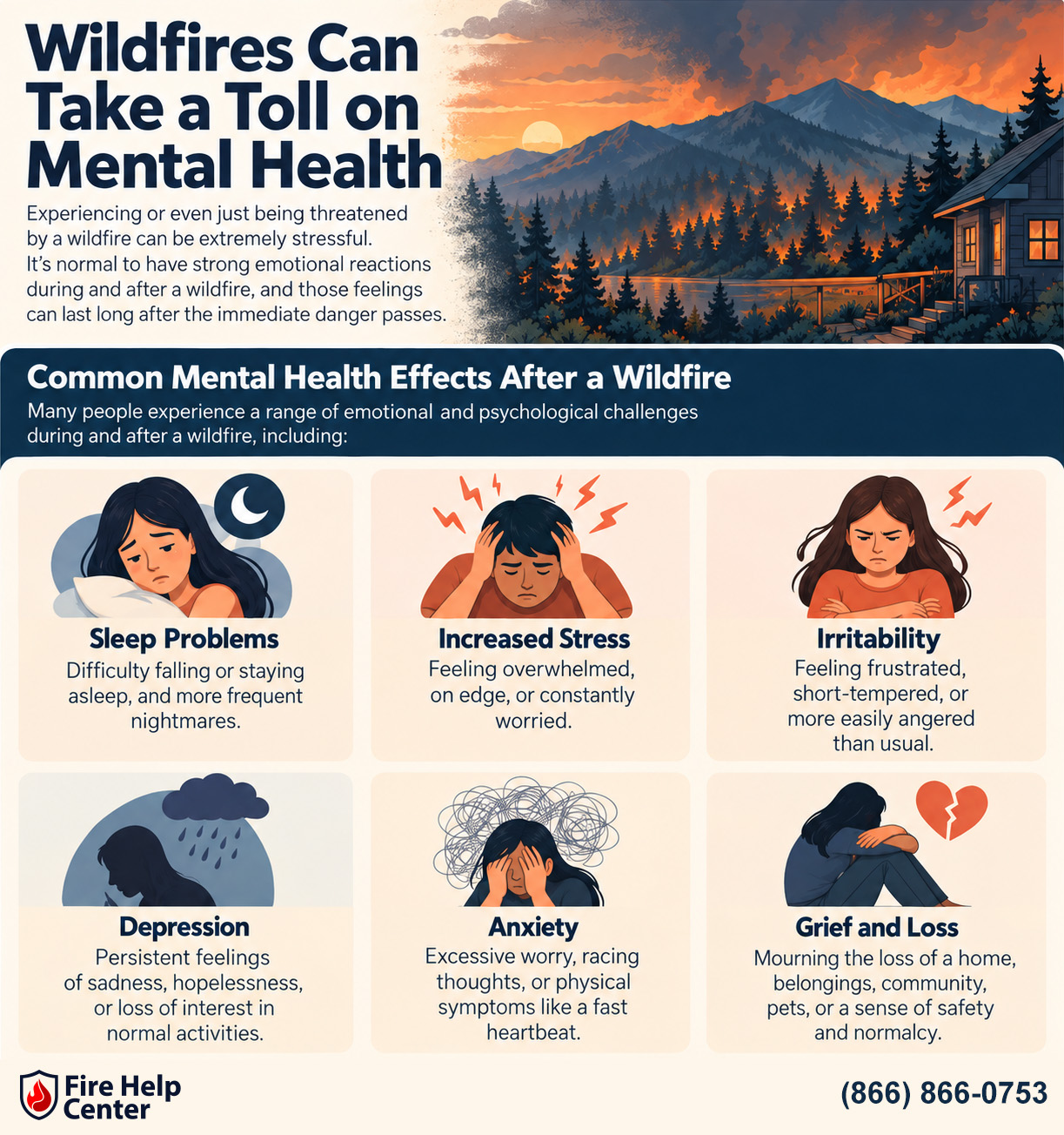
Common Mental Health Reactions After a Wildfire
Experiencing intense emotions after a wildfire is common. It doesn’t mean something is wrong with how you’re coping.
Research following major wildfires has found elevated rates of mental health conditions among survivors, and these sometimes persist for years afterward.
Common mental health effects of wildfires include:
- Difficulty sleeping or recurring nightmares
- Feelings of grief, guilt, or numbness
- Heightened anxiety, especially during future fire seasons or high wind events
- Intrusive memories or moments that feel like reliving the wildfire
- Persistent sadness or loss of interest in daily activities
A study of Southern California residents surveyed 2 to 3 months after the region’s January 2025 wildfires found that people who evacuated had significantly higher rates of both depression and PTSD than those who did not, even after accounting for their mental health diagnoses before the fire.
Sleep-related symptoms are especially common. A broader review of wildfire survivors found that difficulty sleeping and recurring nightmares affected anywhere from roughly 25% to nearly 80% of survivors.
Mental health issues like these often ease with time and support, though some people may not get the help they need due to factors like shame or not knowing where to turn.
Wildfire Grief Doesn’t Always Look Like Grief
Researchers studying the psychological impact of wildfires and other climate-related disasters have described a specific kind of grief tied to losing a familiar place, sometimes called solastalgia.
This kind of grief can show up as ongoing disorientation even when no family member was injured, or a home is eventually rebuilt. A changed neighborhood, a scattered community, and an altered landscape are each losses in their own right.
Ecological grief can also co-exist with anxiety after a wildfire. If you find yourself grieving the harm done to your local environment or your community, you’re not alone.
Risk Factors for Mental Health Concerns After a Wildfire
People who experience the same wildfire can have different levels of distress as they recover. Numerous things influence a survivor’s mental health, depending on what they’ve been through.
These factors can make post-wildfire distress last longer:
- Experiencing a direct threat to life or safety during the fire
- Facing prolonged insurance disputes or delays in rebuilding
- Having a pre-existing diagnosis of depression, anxiety, or PTSD
- Living through repeated evacuations or near-misses over multiple fire seasons
- Losing a home, a community, or the feeling of belonging to a familiar place
None of these factors make lasting distress inevitable. They simply describe who may be at higher risk, which can help explain why some survivors struggle more than others in the weeks, months, and years later.
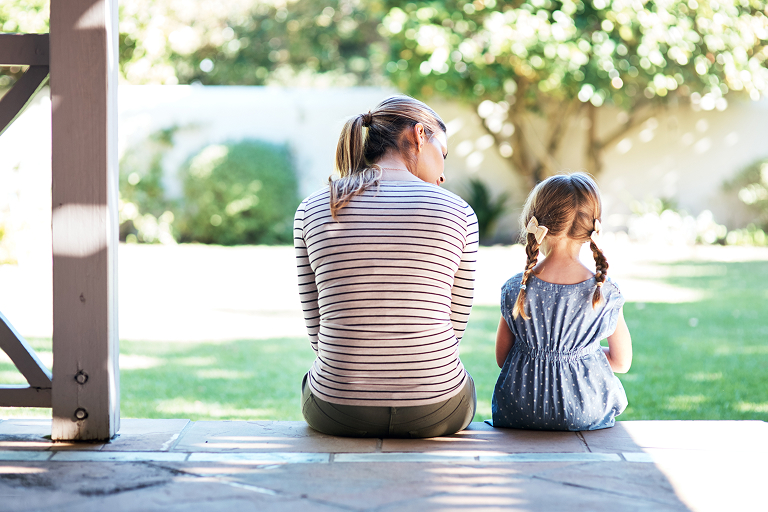
Supporting Children and Family Members After a Wildfire
Children often process wildfires differently than adults, and may show distress through behavior changes or trouble sleeping rather than being able to describe what they’re feeling.
Our guide to wildfire preparedness for children and teens covers this in more detail, including school-based resources and age-specific concerns to watch for.
Signs that a child may benefit from professional support include:
- Acting out scenes from the fire repeatedly in play, weeks or months later
- Avoiding anything that reminds them of the fire, including conversations about it
- Losing skills they had already mastered, such as toilet training or speaking in full sentences
- Regressing to earlier behaviors, like needing a parent to stay in the room to fall asleep
- Withdrawing from friends, activities, or school activities they used to enjoy
Caregivers supporting a child through this should know that their distress affects how a child processes the event, so seeking support for yourself can also help your family.
When a parent manages their own mental health, children tend to feel safer than when their parent tries to hide their distress.
When to Seek Mental Health Support After a Wildfire
There’s no fixed timeline for when your reaction to surviving a wildfire requires professional support from a psychologist, social worker, or mental health counselor. However, a few signals are worth noticing.
It may be time to reach out to your professional if:
- Anxiety or fear is interfering with sleep, work, or relationships for more than a few weeks
- Grief or sadness feels like it is getting heavier rather than easing over time
- Memories of the fire keep intruding without warning, even in safe, unrelated moments
- Substance use has increased as a way of coping
- Thoughts of self-harm or not wanting to be alive show up, even briefly
If you have thoughts of self-harm or not wanting to be alive, that’s a signal to reach out for immediate help. Call or text 988 to reach the 988 Suicide and Crisis Lifeline 24/7.
Finding Help and Wildfire Recovery Support Resources
Several resources exist for wildfire survivors who are struggling with their mental health. These are often separate from general mental health services, allowing you to get support for your crisis-specific needs.
Support after a wildfire is available through:
- County-run mental health lines, such as the Los Angeles County Department of Mental Health’s disaster resources, which many California counties rely on after a major fire
- Crisis counseling assistance programs run through FEMA and SAMHSA following federally declared disasters
- Local nonprofit and community support groups organized for survivors
- School-based counseling resources for children and teens
- The Disaster Distress Helpline and the 988 Suicide and Crisis Lifeline, both available 24/7
If you or your loved ones need immediate mental health support, the Disaster Distress Helpline can be reached at 1-800-985-5990 by call or text 24/7. Their team members speak more than 100 languages and are trained as crisis response counselors.
After major wildfires, county mental health departments and community organizations sometimes set up dedicated lines and free support groups for survivors, so check your county’s local resources to see what’s available where you live.
Get Mental Health Support After a Wildfire
Recovery after a wildfire is rarely straightforward, and reaching out for support does not mean someone has failed to cope. It’s one of the best things you can do for yourself and your loved ones.
If your household also includes older adults, children, or pets and other animals, our wildfire preparedness guides for seniors and caregivers, children and teens, and pets and animals walk through what each group should plan for.
The Fire Help Center team is here to help you understand your wildfire risks, prepare for emergencies, and explore your legal options after wildfires caused by negligence.
Get a free case review or call (866) 866-0753 now to learn more.

Written by: Fire Help Center
Fire Help Center was founded to support individuals and families affected by wildfire-related loss and disaster. Our mission is to provide clear, reliable resources that help people navigate recovery, prevention, and preparedness strategies. We work to ensure no one has to face the aftermath of a wildfire alone.
- 988 Suicide and Crisis Lifeline. (n.d.). 24/7 crisis support by call, text, or chat. Retrieved from: https://988lifeline.org/.
- Eisenman, D., McCaffrey, S., Donatello, I., et al. (n.d.). An ecosystems and vulnerable populations perspective on solastalgia and psychological distress after a wildfire. Retrieved from: https://link.springer.com/article/10.1007/s10393-015-1052-1.
- Federal Emergency Management Agency (FEMA). (2025). Crisis counseling assistance available to LA County wildfire survivors. Retrieved from: https://www.fema.gov/press-release/20250315/crisis-counseling-assistance-available-la-county-wildfire-survivors.
- Isaac, F., Toukhsati, S., Di Benedetto, M., et al. (September 27, 2021). A systematic review of the impact of wildfires on sleep disturbances. Retrieved from: https://www.mdpi.com/1660-4601/18/19/10152.
- Lee, R., Unger, J. B., Soto, D. W., et al. (November 26, 2025). Depression, anxiety, and PTSD among Southern California residents after the January 2025 Los Angeles wildfires. Retrieved from: https://www.cambridge.org/core/journals/disaster-medicine-and-public-health-preparedness/article/depression-anxiety-and-ptsd-among-southern-california-residents-after-the-january-2025-los-angeles-wildfires/D53C4B7A849609F4FC2BA0472A648E35.
- Los Angeles County Department of Mental Health. (n.d.). Disaster mental health resources. Retrieved from: https://dmh.lacounty.gov/our-services/disaster-services/disaster-mh-resources/.
- Substance Abuse and Mental Health Services Administration (SAMHSA). (n.d.). Disaster distress helpline. Retrieved from: https://www.samhsa.gov/find-help/helplines/disaster-distress-helpline.
- Substance Abuse and Mental Health Services Administration (SAMHSA). (n.d.). Survivors of disasters resource portal. Retrieved from: https://www.samhsa.gov/technical-assistance/dtac/disaster-survivors.
- To, P., Eboreime, E., & Agyapong, V. I. O. (September 21, 2021). The impact of wildfires on mental health: A scoping review. Retrieved from: https://www.mdpi.com/2076-328X/11/9/126.